Yeast is a unicellular microorganism that belongs to the Fungus Kingdom. They are chemoorganotrophs so they use organic compounds as a source of energy and do not require sunlight to grow. Yeast also has specific temperatures they grow best in and they often prefer slightly acidic environments. There are many different species of yeast and not all are safe for humans. While there is the Saccharomyces cerevisiae which is the key element in brewing because of its ability it ferment alcohol, there are also yeats such as the Candida albicans, which are opportunistic pathogens and are very dangerous to people.
Yeast in general creates proteins but it reabsorbes half of the protein it secreets to feed itself. The process of genetically modifying the yeast is to prevent the organism from reabsorbing so much of the protein it expels so that it can be harvested by people. The process is simple and only requires scientists to find the proteins in yeast responsible for the uptake functions and genetically knocked them out.
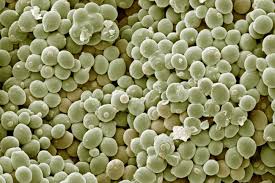
Arxula adeninivorans
Arxula adeninivorans (also called Blastobotrys adeninivorans) is a dimorphic yeast, meaning it grows as a budding yeast up to a temperature of 42 °C, but as a filamentous form at higher temperatures. A. adeninivorans has unusual biochemical characteristics. It can grow on a wide range of substrates and can assimilate nitrate. Strains of A. adeninivorans have been developed that can produce natural plastics, and have been involved in the development of a biosensor for estrogens in environmental samples.
Candida boidinii
Candida boidinii is a yeast notable for its ability to grow on methanol (called methylotrophism). Like other methylotrophic species such as Hansenula polymorpha and Pichia pastoris, it is used as a platform for the production of foreign proteins. Yields in a multigram range of a secreted foreign protein have been reported. A computational method, IPRO, recently predicted mutations that experimentally switched the cofactor specificity of Candida boidinii xylose reductase from NADPH to NADH.[1]
Ogataea polymorpha
Ogataea polymorpha (synonyms Hansenula polymorpha or Pichia angusta) is another methylotrophic yeast (see Candida boidinii). It can grow on a wide range of other substrates; it is thermo-tolerant and can assimilate nitrate (see also Kluyveromyces lactis). It has been applied to the production of hepatitis B vaccines, insulin and interferon alpha-2a for the treatment of hepatitis C, as well as to a range of technical enzymes.
Kluyveromyces lactis
Kluyveromyces lactis is a yeast regularly used for the production of kefir. It can grow on several sugars, most importantly on lactose which is present in milk and whey. It has successfully been applied among others to the production of chymosin (an enzyme that is usually present in the stomach of calves) for the production of cheese. Production takes place in fermenters on a 40,000 L scale.
Pichia pastoris
Pichia pastoris is a methylotrophic yeast (see Candida boidinii and Hansenula polymorpha). It provides an efficient platform for the production of foreign proteins. Platform elements are available as a kit and it is worldwide used in academia for the production of proteins. Strains have been engineered that can produce complex human N-glycan (yeast glycans are similar but not identical to those found in humans.
Saccharomyces cerevisiae
Saccharomyces cerevisiae is the traditional baker’s yeast used widely in brewing and baking. Often the collective term “yeast” is used for this single species. As an expression platform it has successfully been applied to the production of technical enzymes and of pharmaceuticals like insulin and hepatitis B vaccines.
Yarrowia lipolytica
Yarrowia lipolytica is a dimorphic yeast (see Arxula adeninivorans) that can grow on a wide range of substrates. As such, it has a high potential for industrial applications but there are no recombinant products commercially available yet.
 Lex's Blog